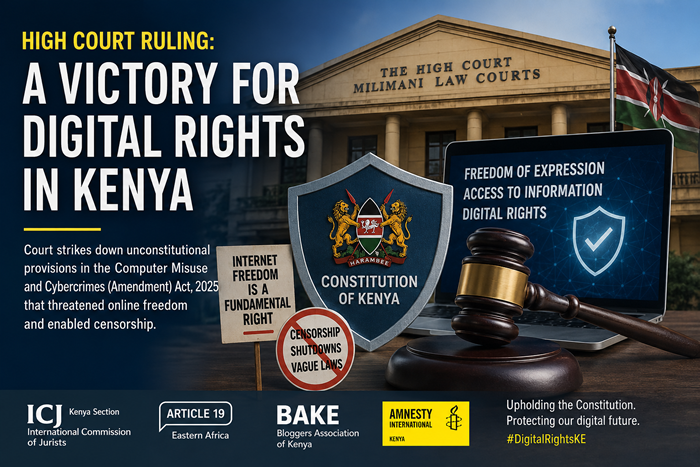
Kenya has taken a significant step in protecting digital rights and freedom of expression following a landmark High Court judgment declaring key provisions of the Computer Misuse and Cybercrimes (Amendment) Act, 2025 unconstitutional.
The decision, delivered by Justice Patricia Nyaundi at the High Court in Milimani, is a major victory for internet users, bloggers, journalists, digital creators, and civil society organizations that have consistently advocated for an open, free, and rights-respecting digital ecosystem.
The petition was filed by the Kenya Section of the International Commission of Jurists (ICJ Kenya), ARTICLE 19 Eastern Africa, and the Bloggers Association of Kenya (BAKE), with the support of Amnesty International Kenya.
A Win Against Administrative Internet Censorship
At the center of the case was Section 6(1)(j)(a) of the amended law, which granted the National Computer and Cybercrimes Coordination Committee (NC4) powers to order internet service providers and digital platforms to disable access to websites and applications suspected of hosting content linked to terrorism, violent extremism, child sexual exploitation, or other unlawful activities.
While the objective of combating harmful online content is legitimate, the Court found that the law gave an administrative body sweeping censorship powers without adequate judicial oversight.
Justice Nyaundi ruled that allowing NC4 to determine whether online content should be blocked amounted to unconstitutional prior restraint, undermining constitutional guarantees on freedom of expression and media freedom.
The Court further emphasized that any limitation of constitutional rights must satisfy Article 24 of the Constitution, which requires restrictions to be clear, necessary, proportionate, and demonstrably justifiable in an open and democratic society. According to the judgment, the State failed to meet this constitutional threshold.
Protecting Free Expression Online
The Court also struck down Section 27(1)(b), which criminalized communication considered “likely” to cause another person to commit suicide.
Justice Nyaundi found the provision to be vague and overly broad because it relied on speculative standards rather than clearly defining what conduct constituted a criminal offence.
The judgment reinforces an important constitutional principle: criminal laws must be precise and predictable. Citizens should not face criminal liability based on subjective interpretations or uncertain outcomes.
For bloggers, content creators, journalists, and ordinary internet users, this finding provides greater legal certainty regarding online speech while maintaining that existing laws can still address genuinely unlawful conduct through constitutionally compliant mechanisms.
Why This Matters for Kenya’s Digital Future
This ruling extends beyond the specific provisions challenged in court. It establishes important principles for future digital legislation in Kenya.
As governments around the world seek to regulate online platforms, artificial intelligence, misinformation, cybercrime, and digital safety, the balance between security and fundamental rights has become increasingly important.
The High Court has reaffirmed that digital governance cannot come at the expense of constitutional freedoms. Measures intended to improve online safety must include adequate safeguards, transparency, accountability, and independent judicial oversight.
The judgment also sends a strong signal that internet shutdowns, website blocking, and content takedowns cannot be implemented through broad administrative powers alone.
BAKE’s Continued Commitment to Digital Rights
Welcoming the ruling, BAKE Chairperson Kennedy Kachwanya described the judgment as a reaffirmation of Kenya’s constitutional values.
“This judgment restores our confidence in the judiciary and affirms that the internet is a space for free expression, not for censorship. We will continue to fight for a digital environment that is open, inclusive, and respectful of fundamental rights.”
ICJ Kenya Chairperson Christine Alai noted that the judgment affirms that restrictions on online content must remain subject to judicial oversight rather than administrative discretion.
ARTICLE 19 Eastern Africa Acting Regional Director Patrick Mutahi described the decision as a victory for the digital rights of all Kenyans, saying the Court had rejected vague and overly broad provisions that criminalized speech based on speculative standards.
Looking Ahead
Kenya has built a reputation as one of Africa’s leading digital economies, with growing innovation in blogging, digital media, fintech, and online entrepreneurship. Sustaining that growth requires a legal environment that protects both public safety and constitutional freedoms.
This judgment provides valuable guidance for future policy-making by reaffirming that digital rights are human rights. Laws governing cyberspace must be carefully crafted to protect citizens from genuine harm without creating avenues for censorship or arbitrary restrictions on free expression.
For BAKE and its partners, the ruling represents not only a legal victory but also a milestone in the ongoing effort to ensure that Kenya’s internet remains open, accessible, and governed by the Constitution.